
 |
| Budapest, Hungary - June 29, 30 and July 1, 2008 |
After a miserable 12 hour train ride from Sarajevo to Budapest in which we think the train was stopped as much as it was going, we reached Budapest. The train also didn't have a dining car for the entire twelve hour duration. So we arrived in Budapest very hungry and with an hour and forty minutes before the start of the Final Match of the Euro Cup. Budapest is the city in which I had found a local guy who rents apartments out and is willing to meet you at the train station to escort you there. He was a year younger than us and I had read good things about him on several different websites. So, despite Daniel's semi-joking suspicion that he was a serial killer, I booked our apartment through him. We were greeted at the train station and helped aboard to different city buses as we navigated our way to the apartment. The apartment was a new one they had just bought and added to the list to be rented out – it was quite nice. Very cute, great location, etc. We had a few hiccups, but they fixed them quickly. As they had just acquired the apartment, they didn't have the washer yet – so we were given keys and directions to another apartment and were encouraged to wash our clothes there. After we left we discovered the hot water wasn't working (post-attempt at a shower), but they had someone come out first thing the next morning and fix it. So a few hiccups, but they took care of them quickly. Not a big deal.
We settled in quickly and set out to meet one of them at a bar where they had staked out a table to watch the final match from. We mis-navigated and then corrected ourselves, and arrived at the game just before half-time starving and frustrated. The bar was atop a building that had been “remodeled” by the Soviets and was absolutely hideous – but the rooftop had a massive projection screen, good speaker system, and good LCD projector that projected the game for several hundred to see with ease. After getting a sandwich in our tummies we felt much better and were able to enjoy the second half. The game wasn't as exciting as some of the others have been, but we enjoyed it. Germany fought until the last second, but Spain triumphed and played a great game.
The next day we had agreed to sleep in a bit. We would have two full days in the city and felt ourselves getting a little tired. Our focus for the day would be to tour as much of the city as we could while working on completing our laundry at another apartment. We decided – per our hosts recommendations, to visit the Jewish Quarter. The Dohany Synagogue in Budapest is the second largest synagogue in the world (second to the one in NYC) and was very beautiful. The synagogue was built during the latter half of the 19th century by a neo-logue group, so there are elements of Catholicism laced into the construction, in that the convenient is at the front of the synagogue instead of the center, and there are two pulpits. The synagogue was within the Jewish Ghetto during the second world war. Now, because Hungary had aligned with Germany and because of certain politicians, the Jewish population of Budapest was not decimated. The Hungarian Jews from the countryside (which were actually Jews who had fled the USSR, Ukraine, and Poland over the past century), were all deported – most directly to Auschwitz. About one third or so of the Jews killed in Auschwitz were Hungarian. But the Jewish population in Budapest managed to be guarded through different politicians and diplomatic maneuverings, and thus, the Jewish population still thrives there today. There were over eighty thousand Jews living in Budapest today. But, I do not want to suggest that the Jews of Budapest didn't suffer – deportations had begun before the Soviets arrived in the city and the Jews of the city were still given harsh work details and little food.
Regardless, the Jewish population in Budapest still exists and continues to survive. To give context – before WW II, 1.5 million Jews lived in Poland, after WW II there were only 6,000-7,000 left. So to have a population of 80,000 within the city reflects a much more preserved and prominent culture. But I certainly don't want to undermine the vast number of Hungarian Jews that were murdered – the majority of the population was killed.
Our guided tour of the synagogue and the memorial sites, was very informative and interesting. We toured the synagogue, a cemetery full of just shy of 3,000 people that was adjacent to the synagogue – something that is traditionally forbidden according to religious beliefs, but was an exception that had to be made late 1944 and during 1945 when the Soviets and Nazis were duking it out and the traditional Jewish cemetery couldn't be reached. We also walked through their memorial section where they had a beautiful stain-glass monument that depicted a black and grey snake (symbolizing the evil of the Nazis) being burned up by a tri-colored flame (the flecks of the flame were yellow, symbolizing the Star of David, and two shades of orange, symbolizing the flames of the crematoriums). We also saw a commemorative willow tree made of silver and stainless steel. Many of the leaves of the tree had a name engraved on it that represented a Jewish man, woman, or child who never received a proper burial. The museum upstairs has many relics and religious pieces, including very old Torah scrolls. There was also a section of the museum dedicated to the Holocaust that was full of pictures and artifacts – the one I found most chilling was a bar of soap that had been made from human fat.
The synagogue has only been restored since 1995, as it was damaged during WW II but was unable to be repaired under the Soviet regime. (Soviets didn't support organized religions). The wrought iron chandeliers were just recently replaced as Hitler had ordered them to be removed and melted down for weapons. (Although, this didn't just happen in synagogues – I remember hearing several similar stories at various churches in Germany – church bells were a targeted source). The fallen church bells of Lubeck, Germany are one of the few anomalies. Many of the artifacts in the museum – as well as the old Torah scrolls – were hidden during the war by Christians and returned to the Jewish community after the war was over.
We spent our afternoon exploring the city more and our evening hanging our laundry up to dry – very exciting to have clean clothes again!
The next day we get up at a decent time, knowing it’s one of our last days of the trip to take it easy in the morning, but also knowing it is our last day in the city. We had muesli left in our suitcase, so I ask Daniel to get milk from the shop around the corner while I shower and step out to discover he has come home with a bountiful feast. Milk, fresh bakery rolls, cheese, meat, yummy stuff. We eat a big breakfast and head out to the train station to buy our sleeper reservations. (We have East passes that work in Austria, Hungary, Slovakia, Czech Republic, and Poland), but need to pay for our bed for the night. Cheaper than a hotel Unfortunately, the international ticket line is ten people long…and in a thirty minute period four people go through….
Over an hour later, we have gotten to know the mom and son in front of us who are from NJ and are pleased that the sleeper was inexpensive, but exasperated at how long our transaction took. Also relieved that the attendant understood us well enough to help us – language was a pretty big barrier in the Hungarian train station.
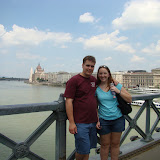
We set off to check out the rest of the city. We had spent the previous day touring the lower part of Buda, so the plan was to check out upper Buda and the highlights of Pest. I would say we were fairly successful. We got to see the Parliament building…one of my favorites – I just love its architecture. We walked across the chain bridge, up to the National Gallery, up to the dome to get a nice panorama of the city, over to the Fisherman’s Bastion (which looked like a gigantic sand castle to me), and managed to run out of time pretty easily. We ate a late lunch/early dinner and headed back to the apartment to pack up our newly dry and clean clothes! We made it to the train station fairly seamlessly – we took some public transport, but still dragged our luggage fairly far, and had plenty of time to spare to board our train. After a few inquiries, several platform workers showed me which car we would be on and we began our night train adventure.
First, they take your tickets for the entire night. Which is fine…but in our case they were passes, so if they lost them, they would lose a lot of money’s worth of tickets. Second, we were in a little sleeper cabin that had to columns of three bunks in a very small space. Daniel’s face was priceless. Luckily, all of them were between 20 and 24 and all of them spoke English! What fun! We spent the first twenty minutes getting settled, so that by the time the train started at 8 we were set. We spent the next three or four hours talking with other young travelers! Once again, what fun! Two girls were traveling together and were from Australia, but were studying in the EU at various places and the other two were a couple, one from Finland and one from New Zealand, so they were tackling how to stay together while not being able to legally stay in any place for too long.
We had a great time chatting with them, talking about travels, discussing universities, environmental policies…all sorts of stuff. We all were tired by midnight and did our best to sleep through the bumpy train, but we had a lot of fun!
We woke up about 25 minutes outside of Krakow, with enough time to wake-up and stumble off the train into the 6 am brightness.
Budapest was a lot of fun and by far the most affordable so far – although that’s not to say that it was cheap. But at least affordable – more in our price range…every once in a while we actually felt like we had gotten a great deal! Very pretty city, lots of neat monuments, renovations still occurring all over – it seems there is a distinct priority list of renovations that the city wants to occur to remove as many Soviet marks and facades as possible, but it is definitely coming along and the phrase “can’t judge a book by it’s cover” is a perfect motto for many of the buildings of this city.


No comments:
Post a Comment