
 |
| Peleliu |
Click on the image above to view my album
**I am continuing to back-blog and am now in Korea! I should have much more reliable internet as of tomorrow afternoon. So I am really hoping to get some pictures added up sometime tomorrow.**
30 June 2010 - Peleliu
Well…we’ve now lost track of days, but in a good way. It’s technically Thursday, and as of the moment I am typing this, Daniel and I have rocked fifteen dives in the past four days – and still have quite a few more to go. We’ve had many phenomenal dives at this point and have seen many awesome fish. The fish aren’t necessarily all that different than what we saw in Florida or in Australia, the difference is in the quantity of fish, the size of the fish, the different variations (colors) of fish, and the never-ending 70-150 foot walls of hard and soft coral. Some examples? I’ve seen many many many different colors of trigger fish, dozens and dozens of schools, two different puffer fish the size of volleyballs (before puffing up), and so much more. It’s spectacular.
Yesterday afternoon we enjoyed an awesome shore excursion to the island of Peleliu, the site of a horrendous battle during World War II. If any of you have watched “The Pacific” on HBO this spring, one or two of the episodes focus on the marines experience in Peleliu – it was an incredibly violent battle in which the marines landed on Orange Beach, attempted to take the Japanese airfield and the Japanese administration building, and then worked their way up “Bloody Nose Ridge.” The skiff took us to the island, where Daniel, myself, Susan, Tom, and Raul met out guide, Tangie Hesus. We hopped into a passenger van and were off.
We visited Orange Beach, the monument where many soldiers were buried until 1957 (they were moved to Arlington at a later date), and the remaining walls of a chapel that had been built on site. Tangie told us of the struggles to gain position on Orange Beach (think Normandy) and told us many stories of marines returning to Orange Beach and the nearby jungle and sharing stories of how their best friends perished. It was sobering to stand on a beach, now calm and peaceful, that had seen so much carnage and death. The monument to the fallen marines had plants arranged to actually spell “USA.” The island of Peleliu itself lost nearly all of its vegetation during the battle – afterwards, the US tried to plant a tree that grew extremely fast to create some cover for the locals. But they planted a pine that was toxic to the indigenous plants, so now they are centering efforts on removing the pesky pine. Much of the island’s vegetation has grown back, but when you look at pictures that were taken where you were standing and see no vegetation at all, it is astounding.
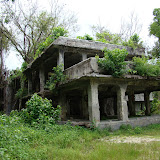
From there we drove through the airfield and onto the Japanese administration building. This building had definitely seen war. The concrete was riddled with mortar divets and bullet holes, there were gaping holes in the walls and ceiling, and rebar was jaggedly jutting out throughout the remains of the building. We got to explore a nearby Japanese bomb shelter – which I found especially eerie, because the men inside were probably forced out with a flame thrower. On some of the pillars there were tributes to the Japanese soldiers who had lost their lives with wreaths bearing a thousand paper cranes.
After stopping to see several different vehicles that had been damaged and abandoned (including a Japanese tank and a US Amtrak), we headed up the steps to Bloody Nose Ridge. Over 11,000 Japanese were entrenched in the ridge, hiding in 600 caves, as 800 snipers were perched, hidden, and ready. Our guide took us back to see a 200 mm rifle that had never been fired (it was about 90% assembled when the US arrived). We also got to go back to some of the caves where the Japanese hid.
Tangie Hesus has also created a museum full of artifacts, correspondence, and photographs documenting the perspective and experiences of both the Japanese and the American troops. We spent a little while walking through the museum and then headed up the hill on Bloody Nose Ridge and paid our respects to the Marine Monument and the Japanese Shrine.
Later on that afternoon we did a dive at Orange Beach and we saw rifle barrels, cargo holds, remnants of ships…and all sorts of different war related carnage. It was all hidden with coral, but was really cool to see. I found my mind imagining how everything got there and also felt like a scuba-historian as I tried to discern whether I was seeing just coral, or historical artifacts.
Night dives require guts. While I was in Australia I did one night dive, but we did it right off the back of the boat – which had a lighted platform. This time…woah. Those of us going on the night dive were briefed, given lights, and loaded onto the skiff. They turned all of the skiff lights off and said for navigating purposes we needed to not use our lights. As we whizzed away from the mothership, rocketing into the dark, mysterious waters, our familiarity with our gear was tested as we all geared up in the black night. The Tuesday night dive was in the German Channel Coral Gardens. The neat thing about a night dive is that you can only see what you illuminate with your flashlight. But, that can also be the intimidating thing. It is very easy to panic or become disoriented as the dark water could seemingly swallow you whole without a light. You are also constantly scanning your surroundings to make sure you don’t swim into any coral or lion fish or jellies. You have to be very aware. …What didn’t help Daniel was that his light died about thirty minutes into the dive. Luckily I was nearby and we shared for a little while but came up early. One cool thing? When you look the opposite way of your light and wave your hand around you can see phosphorescents! I’d always wanted to and I finally did! Also, when you paid closer attention to what was directly in front of your light you could actually see little white wormy things eating other little particles. Really crazy.
Wednesday night’s night dive involved Orange Beach – we zoomed out from the South Dock of Peleliu to the drop zone and essentially did a night dive in a graveyard. This was my favorite night dive that I’ve ever done though – I spotted several red lion fish, a moray eel in the midst of a hunt, and many cargo boxes or fuel tanks that were haphazardly skewed across the bottom – as well as piping and old artillery barrels. It was pretty cool.


No comments:
Post a Comment