Pages

Tuesday, July 27, 2010

Our Final Days

I have to confess that I am now safely back in the United States, after an exhausting 30+ hour journey back to my home in Florida. I have had a few days to enjoy the creature comforts of my own home as well as the happiness of being reunited with my husband. I am slowly beginning to reconnect with friends and family and am realizing – I have so so much to share with everyone! I can’t wait…okay, I can wait (it’s just two more weeks), but I’m very excited to see my new and old students and share stories with them too!

Monday 19 July 2010

The last few days were busy as always. Our final lectures at Korean University explored Korean culture, the Korean education system, and art history and were again rich, interesting lectures that enabled us to learn even more about the country’s past and present We were free the rest of Monday, so I spent the afternoon exploring the city on my own – which meant I got very lost and realized that there is no actual standardization of where North is on a map. Sounds crazy right? Seriously…on my tourist map North was up, on the subway map North was to the right, and on the map at street level North was left. Now, I understand that many other foreign cities would have no map at all…but still – the lack of standardization of North and the lack of street signs presents quite a problem when you are actually hoping to walk and find something! After a harried two hours of speed walking through the city I caved, collapsed in a cab, and returned to the hotel to get ready to meet up with Jenny’s family again.


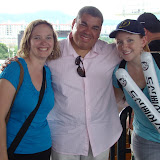
Jenny Park, her mom, and her aunts making me feel incredibly welcome

Monday night I met with Jenny Park (my student from MCC) and her extended family and found myself warmly welcomed in the home of Jenny’s maternal grandmother and quickly surrounded by her many aunts. In no time I felt like family and spent the evening laughing and talking with Jenny and her mother, father, brother, grandmother, aunts, and cousins as we ate an absolutely delicious Korean meal. We finished the night off at a beautiful lounge that overlooked the Han River. In the midst of such a foreign, bustling city, I had made very dear friends.

Tuesday 20 July 2010
Day 14 - Changdeokgung Palace and end of the program
click on the image above to view the album

Tuesday was the last official day of the program with the Korea Foundation. The Korea Society arranged for us to have an additional day in Seoul through the Freeman Foundation (Wednesday), but our formal schedule ended Tuesday. We began the day with a trip to the Changdeokgung Palace gardens which were beautifully lush and serene. After that headed to Korea University for one last lunch, a self-guided campus tour, fill-out-the-evaluation-packet-time, and closing ceremonies. We all changed into suits/ties or dress/heels and discovered we were glad we did…the closing ceremonies were much more formal that I had anticipated. We were each recognized and given a very pretty certificate and cover emblazoned with the Korea University symbol. We soon found ourselves being ushered back onto a bus and over to the Samsung building downtown where we had a very extravagant meal to officially end the program. We got to feel like royalty one more time as we enjoyed skyline views of Seoul and watched the newly made DVD of our field trip (which we all can't wait to receive and share with our friends and families!)

Wednesday 21 July 2010
My Final Day - The Japanese Prison and the Blue House
click on the image above to view the album

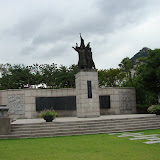
One final day to make the most of Seoul…the question was could we all fight through our exhaustion to truly enjoy it? I met a few of my friends for breakfast and immediately enjoyed the pace of breakfast - if I took five extra minutes I wasn’t going to be late for anything! It was a wonderful feeling! Once we were all ready we set out for the Japanese Prison. The prison was created during the Japanese Occupation (1910-1945) and became increasingly full after the Koreans launched their rebellious March 1st independence movement in 1919. Throughout the occupation the prison was used to execute, torture, silence, and imprison the rebellious spirit of the Korean people and as we walked the grounds we could definitely sense the spirit of the people and the dark periods of oppression they had experienced.

We also wanted to see the Blue House, which is the Korean equivalent of the US White House. We walked a beautiful avenue leading up to the picturesque home which is a gigantic version of a traditional Korean home. After that we visited an English book store that was full of Korean history books (and even though I was already worried about the weight of my suitcases coming home, I found an incredibly intriguing book about North Korea and couldn’t resist). From there we branched off and I spent the afternoon wandering the Insadong market and procuring the last few gifts I needed for my family.

I spent the latter part of my afternoon attempting to pack and hoping that I could squeeze all of my new books in…(which I did!). Our last act of the day was gathering together to enjoy one last Korean BBQ (kalbi). The next morning we all navigated to the airport on our own – LeeAnn and I were forced to acknowledge that we had an embarrassingly large amount of luggage (but we both made it!), and after a fourteen hour flight to JFK we all headed our separate ways to fly on to see our families. I flew into Orlando and was greeted by my husband at the airport – who after eighteen days of dealing with the thirteen hour time difference was definitely happy to see me. After thirty hours of travel and over a month of living out of my suitcase, I was home!!! :)

I have to admit that I was more nervous to visit Korea than I have been to visit any other country. In my defense, this was the first country I visited that had a great number of customs that were truly foreign to me. But, in the end, I found myself pretty comfortable in Korea. The country is captivating and the more I have learned about Korea the more I have felt compelled to learn even more! As I strove to learn about the history and culture of the Korean people, I was reassured that a genuine interest in someone’s country, a friendly smile, and the desire to understand, goes a very long way. The Korean people didn’t expect me to know how everything works in their country, but I often found myself comforted by the kindness of strangers when I attempted to understand how everything works. Humbleness can be a beautiful bridge to understand other cultures. I am incredibly grateful and humbled to have been given the opportunity to learn about Korea first-hand so that I could learn for myself that Korea is indeed, an impressively vibrant country full of hard-working, strong, determined, prideful people who have a wonderfully rich past and an incredibly bright future.

Sunday, July 25, 2010

Hodge Podge: Hanbok and Korean Baseball

Saturday 17 July 2010 and Sunday 18 July 2010
(yes, this is a little late, but I hope you enjoy it anyway!)

Day 11 - Exploring Cultural Traditions

click the image above to view the album

Saturday began with the promise of our first free day since our intense pace had began and we all pushed through Saturday with the knowledge that Sunday was ours. We started our day with lectures at Korea University. The first was an insightful lecture on US-Korean relations that even involved a Forrest Gump reference and the second was an interesting lecture on Korea’s economics that was full of lots of facts and figures that kept you thinking.

After our lectures, we enjoyed lunch in Insadong, which is quickly becoming my favorite shopping area. It stands out from other markets because many of the goods are higher quality and are classic Korean souvenirs/gifts with an artistic slant on them. After lunch, we headed to a place called the Yoo’s Family House and learned about some different aspects of Korean culture – but it was essentially a playing-Korean-house session. We did a tea ceremony and took turns pouring for each other, we made prints from wood blocks, and then we played dress-up.

Dressing up in hanbok, traditional Korean attire, was everyone’s favorite. Imagine thirty-four adult men and women dressing in bright, colorful clothing, with thirty-four cameras being passed back and forth. It was a little nuts, but a lot of fun. My friend LeeAnn and I were given bridal gowns to wear, so we had extra fancy costumes! One of my other friends, Mark, ended up in a ridiculously ornate red and gold guilded outfit that would have been one of royalty (and he was loving it!). We all had a lot of fun, took way too many pictures, and laughed at how ridiculous we all looked.

Day 12 - Korean Baseball = Awesome!

click on the image above to view the album

And then we were free for Saturday night and all day Sunday! Hoorah! I am going to admit that I crashed really hard on Sunday (please bear in mind that I’ve been going non-stop since June 21). I slept in, enjoyed a leisurely morning and afternoon, and then headed to the Korean Ballgame. I had high hopes of doing so many other things, but I could feel myself recharging as I took it easy and decided it was more important to survive the remainder of the trip.

About two thirds of us attended the Korean Baseball game, and it was another event that was one of the highlights of my trip. I am not a huge baseball fan, but the experience itself was awesome! From the second we stepped off the subway we were transported into Korean-baseball-mania. Our senses were assaulted by the fragrances of dried squid and other dried fish as we reached the top of the stairs and found ourselves on street level. We were soon weaving between stands selling various forms of seafood, beer, water, and souvenirs for the game.

Click on the links below to view videos I took from the stands:
The "Mary had a Little Lamb" cheer

Some glimpses of baseball mania

The fans were hard core and were engaged in elaborate, coordinated cheers through the entire game. To enhance their noise level, the majority of the fans used thundersticks (which I quickly bought to join in the fun). The cheers were led on each side (the Giants side and the Bears side) by four dancing cheerleaders and one male who would take turns standing on a stage and leading the crowd. There were also mascots circulating through the crowd (I was on the Doosan Bear’s side) that were not your normal mascots. I watched one of the mascots pull a thunderstick out of a spectator’s hand and hit them over the head with it. When the mascot came up to the top deck, where we were all hanging out, he was very physical and friendly with the people who tried to pose for pictures with him. One of the chants that the crowd was most into was one to the tune of “Mary Had a Little Lamb” and many of the other cheers involved clapping out creative rhythms with the thundersticks. The game was a LOT of fun and to make things even better, the Bears (whose side we were sitting on) won the game!

Sunday, July 18, 2010

Visiting Panmunjom and the DMZ!!!

Day 10 - the DMZ and Panmunjom (Joint Security Area)

Click on the image above to view the album

Friday 16 July 2010

Today was intense.

Most of us woke up feeling a little edgy this morning. People visit the DMZ nearly every day without incident. But that doesn’t mean it is safe. We were about to go to one of the most tense military locations on the planet! We were all excited, but a little on edge.

I have tried to make sure this is as accurate as possible, but I do apologize if I have made a mistake.

Once we reached Imjingak village and we looked over tall barbed wire fences into an expanse of green…we knew we were about to head into the thick of it. We were allowed to take plenty of pictures here, but soon all of the rules were going into effect. To visit the DMZ you have to pre-register with South Korea’s government (with your passport) and there’s only a few agencies to work arrange your visit through. I may be wrong, but it’s my understanding that Koreans living in the Republic of Korea (South) can only get as far as Imjingak, the northernmost town.
We had ten or fifteen minutes in the village and then headed onto the first checkpoint where they looked at the zoom on our cameras and checked our passports. Then the rules that had been shared with us started to go into effect as we headed to Panjunmon, also called the “JSA” or Joint Security Area, which is the area monitored jointly by the United States, the United Nations, and the Republic of Korea. We pulled up to the JSA and were briefed in a building at Camp Bonifas, which is named after Captain Bonifas, who was killed by North Koreans during the Axe Murder incident. Captain Bonifas and a group of men were chopping down a tree that was obstructing their view of the bridge that led to North Korea. The North Koreans came across the bridge, overwhelmed the men, and murdered Captain Bonifas. The motto of the JSA is “In Front of Them All” (meaning, they’re the first line of defense for the people living in the Southern half of Korea).

So we entered Camp Bonifas and received our briefing. These are some of the rules we had to abide (some of these were disclosed before we left, some later):

1. You must wear long pants (no jeans), a collared shirt, and close toe shoes.
2. For the shoes it’s recommended you wear ones you can run in.
3. No gum or drinking any liquids
4. Once past the checkpoint, no standing up on the bus
5. Do not put your hands in your pocket
6. Do not wave or point at anything or anyone
7. No photographs, unless told otherwise
8. Go only where the guide allows you to go – most of the green fields contain live mines
9. Do not speak to anyone
10. If you consumed any alcohol prior to visiting the DMZ area, you cannot participate
11. No video recorders
12. Do not touch anything in the conference room
13. You must walk in two single file lines
14. You can carry nothing but your camera with you, no case, no purse, nothing that could hold weapons and make you seem suspicious to the North Koreans – meaning you had to find a place to put your passport and money…I used my money belt.
15. You must sign the Visitor Declaration form that recognizes “the visit to the Joint Security Area at Panmunjom will entail into a hostile area and possibility of injury or death as a direct result of enemy action.”

Wow. To top it off, in one of our previous lectures we talked about North and South relations and were reminded of the recent Cheonan incident, the two women who were hiking and were arrested, and the S Korean tourist who was shot to death by N Korean military on a beach.

It’s tricky to explain all of the details of what happened after the briefing – it all happened pretty quickly, tensions were high, adrenaline was pumping a little, and so it’s kinda tricky to recount, but here’s the highlights:

We exited the JSA briefing area with our new UNCMAC Guest badge…that had the UN logo on it!!, and boarded a bus…only it wasn’t our bus, it was a military bus that was driven by a soldier. We now had an assigned guard standing at the front of the bus that was from the Republic of Korea. We were told to do everything he said. (The ROK guys have to be bigger than the average soldier, are chosen based on their appearance, their ability to fluently read and write in English and Korean, military performance, and must have a black belt in a martial art).

We drove for a while…suddenly the South Korean flag was waving on a pole as we caught a glimpse of the South Korean village of Taesong-dong (the South Korean village of people who didn’t want to relocate when the Military Demarcation Line was drawn). As we drove on the road there were two big blue poles that we drove between and we were told we were officially in the de-militarized zone – which they reminded us is ironically very militarized. Then, off in the distance we caught a glimpse of the red North Korean flag waving over Propaganda Village – wow! Fun fact? North Korea erected a flag pole in their propaganda village, the South Korean village put a boastingly tall flag pole (around 100 m) up, and to best them North Korea constructed the world’s tallest flag pole at 160 m in height.

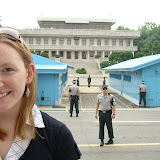
We pulled up to the Freedom House and were ushered out of the bus and into two single file lines where we were march up and down some stairs and suddenly found ourselves outside again, this time facing conference row with the North Korean building mirroring on the other side. Wow!

I only saw soldiers on our side, but they looked fierce. We entered the conference room and they shut the door. We had two soldiers in there with us, one stood in the center of the room the other with his back to the door North Korean soldiers would enter. We were told touch nothing, do not go past the edge of this table, and we had a few seconds to take pictures – go! In succession there were 30-40 cameras powering up, lens caps popping off, and clicking commencing. I was technically past the Military Demarcation Line that ran through the center of the building and was standing in North Korea!

I managed to get a few pictures – I even dared to step near the edge of the table and our tour guide took our picture. And before I knew it “No more photos!” was shouted, and out of the corner of my eye I saw three North Korean soldiers goosestepping towards our building – I think I audibly gasped, felt my heart skip a few beats, and had a personal yikes moment. It was all real. I was suddenly incredibly aware that I was standing at one of the greatest military hotspots in the world. W were rushed out of the room with no explanation and lined up on the steps of the Freedom House, facing North Korea.

Suddenly, there were several North Korean soldiers between the MDL (the line) and their building and a flock of tourists came out onto the steps and started snapping many pictures of us. …Maybe that’s why we were supposed to dress nicely (long pants, no jeans, and a collared shirt generally spells out business attire). Hmm. Our guide suddenly said we could take photos and again we all started clicking away. “No photos” was commanded again and we were quickly led back through the building onto our bus. We drove around the building, and when we were driving by conference row we were again given photo permission…but it was taken away in seconds.

We had another “photos” and “no photos” moment when we pulled up to the Bridge of No Return that links N and S Korea, and is also the site of the Axe Murder Incident. As we drove through the demilitarized zone there was a beautiful flock of white birds (the DMZ is essentially a no man’s land and has become a haven for bird life since it is all undisturbed territory) and our guide again let us take pictures as the bus idled, but we had to be given permission to stand. “No photos.” We again drove within sight of the propaganda village with the gigantic red flag waving overhead. But, no photos. (I have since researched this, because I had a friend who went to the DMZ and had photos of the village. Typically when at the Freedom Building tourists are allowed to climb up a pagoda that has an observation deck and take pictures from above. We were not given this opportunity. I think it’s because of the sinking of the Cheonan a few months ago, but I have not confirmed this yet.) The tourists on the North Korean side went up to an upper level of their building and took pictures...they don't exactly have to worry about a US or ROK soldier arbitrarily shooting them.

We whizzed through the rest of the demilitarized zone, crossed a very creepy as-far-as-the-eye-can-see stretch of fencing and barbed wire, and soon found ourselves driving past the blue poles again. We pulled up to the JSA area and piled into the gift shop where we made a mad run on all of the goodies. I am very proud to say I am now the owner of a piece of the DMZ (I have barbed wire) and a few other cool things that will make my history classes even cooler. :)

They had switched out our buses while we were in the gift shop (they were very ninja with the bus switching) and we were headed back to safer areas. As exciting as it was we all breathed a sigh of relief as we passed the last barbed wire checkpoint and were allowed to take pictures again. Whew.

We had a great lunch – another meal where we got to cook our own beef on a table grill and had a free mid-afternoon in Seoul. I took a nap and accidentally ended up in a coma in which an alarm clock, two calls from the friend I was supposed to meet, and another friend banging on my door could not rouse me. Yikes. …I guess traveling since the night of June 20th is catching up with me. I'm sure the adrenaline rush didn't help either (although, I am relieved to say, this rush was not nearly as severe as the adrenaline rush I had during the bomb scare in the Israeli airport)

Today was an awesome one – I was always jealous of people who went to Berlin before the wall fell. Hopefully things will improve between North and South Korea and I will witness the reunification in my lifetime.

Friday, July 16, 2010

Historical Sites around Gyeongju, Bulguksa Temple, and Hyundai Heavy Industries

Day 8 - Historical Sites around Gyeongju and Bulguksa Temple

Click on the image above to view the album

Day 8: Wednesday 14 July 2010

Today will be a shorter entry. We visited many sites all around Gyeongju today, but they will be best described in the album. I am guilty of caving and going to pizza hut for lunch. I have eaten many traditional Korean meals in the past few days and needed something that tasted the way I expected to…and will confess…it tasted fantastic. We spent the afternoon at the Gyeongju Museum viewing many beautiful artifacts that were excavated from a few of the Silla tombs in the area. We also visited the Seokguram Grotto, which is the last official stop on the Silk Road! It is a cave carved into the side of the Gaya Mountains that houses a beautiful statue of Buddha, looking out over the valleys and at the Sea of Japan (which we could see from the hill!).

Because of the danger of being looted and pillaged along the Silk Road, “hotels” were set up along the mountain that were caves carved out of the sandstone. They were up on ledges and could only be reached by ladder. The idea is that you would carry all of the goods you were selling up to your room and then pull up your ladder so that no one could reach you or steal your goods. And thus, they carved out a cave and placed a Buddha inside to protect those on the Silk Route. Really cool!
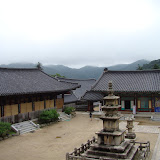
From there we went to another UNESCO world heritage site that was absolutely beautiful – the Bulguksa Temple. We were even able to stick around and watch the monks sound the bell! I have a great video to share with my students when I get back!

And then, we enjoyed a yummy, yummy dinner of kalbi, or Korean BBQ in which we sat at tables of four with a grill in the middle of our table and grilled our own ribs (like the meal the Parks had shared with me). It was a great end to our evening and we all sat outside enjoying the weather, grilling out, laughing, and recounting our favorite experiences from the past few days.

Day 9 - Hyundai and Seoul

click on the image above to view the photos

Day 9: Thursday 15 July 2010

Today’s entry will be a quick one, so I’m combining these too. We were around Gyeongju and the surrounding area until about one o’clock today as we visited one last Silla tomb, Hyundai heavy industries, a seafood buffet, and a loooong 4-5 hour bus ride back to Seoul. Hyundai heavy industries was pretty cool. They make so much more than cars! The corporation was founded by a guy named Asan who built an incredible empire. Along with cars, Hyundai also constructs many different large freight and tanker ships, submarines, construction equipment, engines, industrial robots, power plants (electrical, nuclear, wind, and solar), offshore oil rigs, oil and gas plants, process equipments… you name it, they make it! We got to take a bus tour of the shipyard and dry docks and were blown away at the magnitude of the ships – holy cow! We also learned that the benefits for the employees are extremely good – education is free for everyone’s children and they have 18,000 apartments available to be rented by their employees.

Our tour guide (not our Hyundai guide, but the one who has been with us on the bus for many days), explained to us that in Korea everyone wants to graduate and work for the large corporations because the pay is much higher than smaller businesses, the benefits are much better, and it is the iconic job to have. She said the average Korean makes $2,300 a month, but the average Hyundai employee who has been working as a constructor for ten years makes $5,000 a month. Big difference. She says there is a major need for people in the smaller industries because everyone desires to work for the large companies (Hyundai, Samsung, LG, etc) that it’s all or nothing – some people continue on the graduate school rather than work for a small company.

We are supposed to have a free evening when we arrive in Seoul tonight and I think we’re all looking forward to a few hours of shopping and leisure time – it’s been a crazy schedule during the field trip, but an absolutely amazing one.

Tomorrow….we are going to the DMZ! I am 98% excited and about 2% apprehensive…but I think the apprehensive part of me is the part that will keep me grounded in reality and will keep my wits about me tomorrow. I’m so excited about it, but cognizant that this is not the place to mess around or bend rules. I will take pictures wherever I can, but can genuinely guarantee that there will not contraband pictures.

Thursday, July 15, 2010

Learning the Confucian way at Oksan Seowon and Yangdong Village

Day 7: Oksan Seowon and Yangdong

Day 7: Oksan Seowon and Yangdong Village

click on the image above to view the album

Today was one of my favorite days of the trip. We did two things that I can genuinely say I would have never had the opportunity to do on my own. We began our day by visiting a Confucian Shrine-Academy called “Oksan Seowon.” To reach Oksan Seowon we had to enter the woods and step down a beautiful trail that led us over a stream to the walled-in academy in the mountains. We walked through the academy and all sat down on a large open porch to listen to Dr. Peterson’s lecture. (this means that we removed our shoes, stepped up onto the wooden porch with socks, and sat on the floor in whichever way was most comfortable). The main focus of this lecture was Korean education – we were in an academy after all. We talked about the exam system that existed in Korea for centuries and the tests that people would take to become civil servants, leaders in the military, or technical positions (lawyers, doctors, accountants, scientists, and translators). There were three levels of exams in the civil service category (which was the most difficult and seen with the greatest regard) that were at the provincial, national, and palace level. For the national civil service exam, it was only offered every 3 years (although over time, that rule was bent and it was offered more frequently) and only 33 people pass the exam every time. I hadn’t realized it was that difficult an exam! Wow!

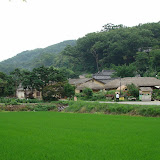
After about an hour and a half we left the beautifully peaceful academy and headed to lunch in Yangdong Village. The village was wonderful. The village is maintaining the exterior of its facilities as it was during the Choson dynasty. The houses were all nestled in among the hills and were all tucked away down one garden path after the other. The homes had gates that led into the courtyards of beautiful thatched houses. It was just precious.

We started out with a lunch in which we sat on the floor at low tables and enjoyed a meal of rice and many of the classic dishes. From there Dr. Peterson took us on a tour of the village and led us up and down many earthen pathways and described his connection to the village. Dr. Peterson has a long running relationship in Yangdong and has been there many times, both on his own and with students. He actually brought a group of BYU students to the village to stay for six weeks. The village agreed to allow him to stay with 15-20 students in a house in the village and because they were students refused to allow them to pay any rent. On a different occasion a couple invited Dr. Peterson, his family, and sixteen students to live with them and cooked them meals for over a month…again for free. The generosity of the Korean people astounds me. He explained that they worked in the village and taught English to the village children to return the favor. But still…how amazing! The simplicity of the village, the peacefulness of the sleepy mountains all around them, and the closeness with nature was just wonderful.

After visiting many significant spots around the village we had the distinct honor of meeting with the village elder who was the 17th elder in his family. Wow. We were invited to sit on his large meeting porch (again with socks, communally of the floor all at the same level), as his wife offered us cold plum tea, watermelon slices, and homemade rice cakes. The village is very Confucian. As elder he is the leader of the people and has a duty to respect and take care of them, as they are very loyal and respectful to him as well. He openly admitted that it was a little awkward to sit in the meeting hall with all of us, because women from the village do not meet on the porch with men.

We sat mystified as Dr. Peterson translated back and forth between us. We learned that his grandfather had protested the Japanese occupation by not cutting his ponytail after the top-knot decree and refused to enter the Japanese education system. He also explained some of the finer details of some of the five Confucian relationships, discussing especially the relationship between parent and child. He outwardly claimed Confucianism is a living/practiced belief system, not a religion. And he said “democracy is not the best thing for Korea, but it is probably better than anything else.” It was all fascinating! At the end of our meeting he said he was going to go to dinner with us but we had to promise not to ask him any more questions, he explained that he finds speaking as the sole representative of his village is a very heavy burden because he feels great responsibility as the only one explaining the perspectives and beliefs of his people. Wow. I can guarantee you that we left him alone.

We enjoyed a really unique dinner at a lotus restaurant that creatively served all parts of the lotus plant and flower within the meal. The breaded seed pods that were lightly fried and then cooked in yellow curry were my favorite. It was really great food. I had had a few iffy meals at lunch and at dinner the previous night, so I was very hungry and ate unabashedly. And yes, after sitting on the floor for an hour and a half at the academy, about an hour for lunch, another hour for a lecture in the village on Korean literature, and an hour or two with the village elder, we ate dinner at the lotus restaurant on the floor. My age gave me away, because I was feeling pretty decent and everyone else was miserable. We ended the dinner with a great performance of a traditional pansoori song from one of the elder’s sons as he boldly stood in front of forty of us and sang. We boarded the bus and drove away waving vigorously add the elder and his family as they stood in modern clothing, grinning, and waving right back. It was a perfect way to end an amazing day.

Wednesday, July 14, 2010

A Day Delay...(Beth needs sleep!)

Yesterday was one of my favorite days of the entire trip...so I have LOTS of pictures and lots of information to share! Today was another busy day that involved quite a few interesting stops. I am exhausted. And thus, I am officially behind.

I will post as much as I can very soon. Things to look forward to? I will tell you of my visit to a Confucian Academy in the mountains, a visit to a beautiful village that still exists as it did during the Choson dynasty, and a conversation our group had with a 17th generation village elder on his five hundred year old porch! Sounds amazing? It was!

We are spending the morning at Hyundai tomorrow, but I have four or five hours on the bus in the afternoon to nap, listen to Dr. Peterson's lectures, and work on catching up on the blog, and I fully intend on doing so!

More very soon! :)

Tuesday, July 13, 2010

Haeinsa, the Tripitaka Koreana, and the Silla Tombs

Day 6: Monday 12 July 2010
Day 6 - Haeinsa and Silla Tombs

Click the image above to view the album

We checked out of our beautiful hotel and headed on for Haeinsa. I was especially excited about this excursion – and it did not disappoint!

Generally you have to hike up the hill as part of the process of readying yourself to enter the Buddhist Temple. Here two there are gates that protect you as you pass through them. Technically, walking up the entire mountain would be a multi-day journey, again to prepare you for your arrival on sacred grounds. Due to time constraints we actually drove up most of it, which was a little disappointing, but by doing so we witnessed the sounding of the bell that called everyone to prayer. The sounding of the fish calls all of the creatures of the seas, the cloud calls all the birds and heavens, the drum calls all the animals on earth, and the ringing of the bell temporarily relieves those in hell from anguish and calls the people to prayer.

We made it into the Haeinsa Temple complex with enough time to hear the bell sounding and then witness the prayer service. We watched the beauty of the service as one of the monks voices lilted through the courtyard that overlooked rolling green Gaya mountain range that peaked out from misty clouds. The interior of the main temple was very beautiful, but again, taking pictures would have been offensive.

We were soon led to lunch and briefed on the “rules” about how to eat among the Buddhist monks. There were two rules. One, no talking. Two, everything on your plate must be eaten. So, we approached the buffet style line (that contained a few modest dishes) and carefully placed food on our plates that we knew we would have to finish ourselves. We ate quietly, contemplatively, and reflectively. It was actually quite nice and made you reflect on how much food you truly needed. Some of us were more concerned about being able to finish all of our food than others, but we all made it!

After lunch, we visited the Tripitaka Koreana, which was something I was very excited to see! This is a collection of woodblocks that the Buddhist monks carved to create a comprehensive collection of the Buddhist documents on 81, 258 wooden blocks. The Mongols invaded in the 1200’s and burned the collection to the ground, but the monks persevered and recarved the blocks in 16 years. Thus we stood outside one of the most comprehensive collections of Buddhist documents, admiring the 700+ year old works. Pretty awesome.

We enjoyed the nice long walk down the mountain as we wound through the peaceful forest path that ran along side a beautiful babbling brook. Our next stops were sights that were of historical relevance to the beginnings of the Silla Dynasty, which historians claim lasted from 57 BCE – 918 CE. It was originally one of four dominant kingdoms, but later unified the peninsula in 668 CE under its authority. Our first site was the site of an old well that was claimed to be the place where the Bak Hyeokgoese, the first Silla King, was discovered. We also visited Orung which means “five tombs” and houses most of the first five Silla Kings. Last, we went to another well site where Alyonyjong, the woman who became the first king’s wife, was supposedly found.

Dinner was a classic Korean table dinner where we sat on the floor and ate a meal from the many different dishes on the table which ranged from potatoes, mushrooms, kim chi, shark, and whole fish that stared you in the eye. My pictures don’t truly do justice to the beautiful sights of the Gaya Mountains that I soaked in as a stood at the steps of the Haeinsa temple, but hopefully you will enjoy them just the same. It was a wonderful day - I could spend hours standing at the steps of the temple soaking in the beauty of the Gaya mountains as they slip in and out of fog.