Pages

Thursday, July 15, 2010

Learning the Confucian way at Oksan Seowon and Yangdong Village

Day 7: Oksan Seowon and Yangdong

Day 7: Oksan Seowon and Yangdong Village

click on the image above to view the album

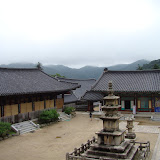
Today was one of my favorite days of the trip. We did two things that I can genuinely say I would have never had the opportunity to do on my own. We began our day by visiting a Confucian Shrine-Academy called “Oksan Seowon.” To reach Oksan Seowon we had to enter the woods and step down a beautiful trail that led us over a stream to the walled-in academy in the mountains. We walked through the academy and all sat down on a large open porch to listen to Dr. Peterson’s lecture. (this means that we removed our shoes, stepped up onto the wooden porch with socks, and sat on the floor in whichever way was most comfortable). The main focus of this lecture was Korean education – we were in an academy after all. We talked about the exam system that existed in Korea for centuries and the tests that people would take to become civil servants, leaders in the military, or technical positions (lawyers, doctors, accountants, scientists, and translators). There were three levels of exams in the civil service category (which was the most difficult and seen with the greatest regard) that were at the provincial, national, and palace level. For the national civil service exam, it was only offered every 3 years (although over time, that rule was bent and it was offered more frequently) and only 33 people pass the exam every time. I hadn’t realized it was that difficult an exam! Wow!

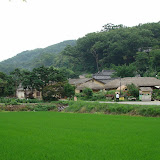
After about an hour and a half we left the beautifully peaceful academy and headed to lunch in Yangdong Village. The village was wonderful. The village is maintaining the exterior of its facilities as it was during the Choson dynasty. The houses were all nestled in among the hills and were all tucked away down one garden path after the other. The homes had gates that led into the courtyards of beautiful thatched houses. It was just precious.

We started out with a lunch in which we sat on the floor at low tables and enjoyed a meal of rice and many of the classic dishes. From there Dr. Peterson took us on a tour of the village and led us up and down many earthen pathways and described his connection to the village. Dr. Peterson has a long running relationship in Yangdong and has been there many times, both on his own and with students. He actually brought a group of BYU students to the village to stay for six weeks. The village agreed to allow him to stay with 15-20 students in a house in the village and because they were students refused to allow them to pay any rent. On a different occasion a couple invited Dr. Peterson, his family, and sixteen students to live with them and cooked them meals for over a month…again for free. The generosity of the Korean people astounds me. He explained that they worked in the village and taught English to the village children to return the favor. But still…how amazing! The simplicity of the village, the peacefulness of the sleepy mountains all around them, and the closeness with nature was just wonderful.

After visiting many significant spots around the village we had the distinct honor of meeting with the village elder who was the 17th elder in his family. Wow. We were invited to sit on his large meeting porch (again with socks, communally of the floor all at the same level), as his wife offered us cold plum tea, watermelon slices, and homemade rice cakes. The village is very Confucian. As elder he is the leader of the people and has a duty to respect and take care of them, as they are very loyal and respectful to him as well. He openly admitted that it was a little awkward to sit in the meeting hall with all of us, because women from the village do not meet on the porch with men.

We sat mystified as Dr. Peterson translated back and forth between us. We learned that his grandfather had protested the Japanese occupation by not cutting his ponytail after the top-knot decree and refused to enter the Japanese education system. He also explained some of the finer details of some of the five Confucian relationships, discussing especially the relationship between parent and child. He outwardly claimed Confucianism is a living/practiced belief system, not a religion. And he said “democracy is not the best thing for Korea, but it is probably better than anything else.” It was all fascinating! At the end of our meeting he said he was going to go to dinner with us but we had to promise not to ask him any more questions, he explained that he finds speaking as the sole representative of his village is a very heavy burden because he feels great responsibility as the only one explaining the perspectives and beliefs of his people. Wow. I can guarantee you that we left him alone.

We enjoyed a really unique dinner at a lotus restaurant that creatively served all parts of the lotus plant and flower within the meal. The breaded seed pods that were lightly fried and then cooked in yellow curry were my favorite. It was really great food. I had had a few iffy meals at lunch and at dinner the previous night, so I was very hungry and ate unabashedly. And yes, after sitting on the floor for an hour and a half at the academy, about an hour for lunch, another hour for a lecture in the village on Korean literature, and an hour or two with the village elder, we ate dinner at the lotus restaurant on the floor. My age gave me away, because I was feeling pretty decent and everyone else was miserable. We ended the dinner with a great performance of a traditional pansoori song from one of the elder’s sons as he boldly stood in front of forty of us and sang. We boarded the bus and drove away waving vigorously add the elder and his family as they stood in modern clothing, grinning, and waving right back. It was a perfect way to end an amazing day.

Wednesday, July 14, 2010

A Day Delay...(Beth needs sleep!)

Yesterday was one of my favorite days of the entire trip...so I have LOTS of pictures and lots of information to share! Today was another busy day that involved quite a few interesting stops. I am exhausted. And thus, I am officially behind.

I will post as much as I can very soon. Things to look forward to? I will tell you of my visit to a Confucian Academy in the mountains, a visit to a beautiful village that still exists as it did during the Choson dynasty, and a conversation our group had with a 17th generation village elder on his five hundred year old porch! Sounds amazing? It was!

We are spending the morning at Hyundai tomorrow, but I have four or five hours on the bus in the afternoon to nap, listen to Dr. Peterson's lectures, and work on catching up on the blog, and I fully intend on doing so!

More very soon! :)

Tuesday, July 13, 2010

Haeinsa, the Tripitaka Koreana, and the Silla Tombs

Day 6: Monday 12 July 2010
Day 6 - Haeinsa and Silla Tombs

Click the image above to view the album

We checked out of our beautiful hotel and headed on for Haeinsa. I was especially excited about this excursion – and it did not disappoint!

Generally you have to hike up the hill as part of the process of readying yourself to enter the Buddhist Temple. Here two there are gates that protect you as you pass through them. Technically, walking up the entire mountain would be a multi-day journey, again to prepare you for your arrival on sacred grounds. Due to time constraints we actually drove up most of it, which was a little disappointing, but by doing so we witnessed the sounding of the bell that called everyone to prayer. The sounding of the fish calls all of the creatures of the seas, the cloud calls all the birds and heavens, the drum calls all the animals on earth, and the ringing of the bell temporarily relieves those in hell from anguish and calls the people to prayer.

We made it into the Haeinsa Temple complex with enough time to hear the bell sounding and then witness the prayer service. We watched the beauty of the service as one of the monks voices lilted through the courtyard that overlooked rolling green Gaya mountain range that peaked out from misty clouds. The interior of the main temple was very beautiful, but again, taking pictures would have been offensive.

We were soon led to lunch and briefed on the “rules” about how to eat among the Buddhist monks. There were two rules. One, no talking. Two, everything on your plate must be eaten. So, we approached the buffet style line (that contained a few modest dishes) and carefully placed food on our plates that we knew we would have to finish ourselves. We ate quietly, contemplatively, and reflectively. It was actually quite nice and made you reflect on how much food you truly needed. Some of us were more concerned about being able to finish all of our food than others, but we all made it!

After lunch, we visited the Tripitaka Koreana, which was something I was very excited to see! This is a collection of woodblocks that the Buddhist monks carved to create a comprehensive collection of the Buddhist documents on 81, 258 wooden blocks. The Mongols invaded in the 1200’s and burned the collection to the ground, but the monks persevered and recarved the blocks in 16 years. Thus we stood outside one of the most comprehensive collections of Buddhist documents, admiring the 700+ year old works. Pretty awesome.

We enjoyed the nice long walk down the mountain as we wound through the peaceful forest path that ran along side a beautiful babbling brook. Our next stops were sights that were of historical relevance to the beginnings of the Silla Dynasty, which historians claim lasted from 57 BCE – 918 CE. It was originally one of four dominant kingdoms, but later unified the peninsula in 668 CE under its authority. Our first site was the site of an old well that was claimed to be the place where the Bak Hyeokgoese, the first Silla King, was discovered. We also visited Orung which means “five tombs” and houses most of the first five Silla Kings. Last, we went to another well site where Alyonyjong, the woman who became the first king’s wife, was supposedly found.

Dinner was a classic Korean table dinner where we sat on the floor and ate a meal from the many different dishes on the table which ranged from potatoes, mushrooms, kim chi, shark, and whole fish that stared you in the eye. My pictures don’t truly do justice to the beautiful sights of the Gaya Mountains that I soaked in as a stood at the steps of the Haeinsa temple, but hopefully you will enjoy them just the same. It was a wonderful day - I could spend hours standing at the steps of the temple soaking in the beauty of the Gaya mountains as they slip in and out of fog.

Monday, July 12, 2010

Field Trip! King Sejong’s Tomb and Cheongju

Day 5: Sunday 11 July 2010

Day 5: King Sejong's Tomb and the Cheongju Printing Museum

Click on the image above to view the album

Our field trip starts today! We are taking a five day field trip to explore some of the historical sites around the rest of the Southern peninsula. Today we started out with a two-ish hour drive to see King Sejong’s Royal Tomb. When we got there Dr. Peterson explained that when entering tombs or other holy sites there are three paths. The central path is usually raised, or more ornate, and is designated for the spirits. Thus, as a humble person you enter on the right and walk the path on the right side to enter and then walk the path on the left side when you exit. You also pass through several gates on the way that guard against. As you pass through the gates, you are preparing yourself to be on sacred ground.

When we reached the tomb, there were stone statues of men, rams, and tigers all guarding the tomb, as well as a stone altar to offer the spirit food. King Sejong was the leader of the Choson dynasty who created the hangul alphabet for the common man. Before this point Koreans used Chinese characters, but the amount of time needed to thoroughly learn all of them meant that only scholars and elite were literate. King Sejong wanted to created a way of communicating that would be open to all. He also greatly encouraged scientific research and development and there are many useful inventions from this time that were either created by King Sejon himself or were constructed with the help of his patronage.

After we left the tomb, we headed to a different city for lunch which was a very traditional dish, chicken ginseng soup. Each of us received a bowl full of still boiling liquid with a small baby chicken that had been stuffed with rice, dates, chestnuts, and ginseng, and then boiled for hours. It was delicious. We had a few spare minutes after lunch and walked through some really neat shops and markets.
Then we headed to the Cheongju Printing Museum where the world’s first moveable type printing press was created in 1377, seventy-eight years prior to Gutenberg. We learned how the monks made the character stamps with beeswax, clay slurry, and bronze. The only Cheongju printing press left is currently in France. It’s a point of contention, but the French claim they bought it and have the receipt.
After exploring the process and the museum, we were led to the “experience room” to make our own books. Which sounds like fun, right? It wasn’t. It was neat to take paper and get an ink rubbing from a woodprint and it was fun to decorate our covers by rubbing them on woodboards with wax…but…there was a very specific way they wanted us to do everything. This was not an open, friendly crafts project. If we messed up they took the book/material out of our hand, impatiently did it for us, and handed it right back. If it wasn’t perfect it was not okay. And we soon found ourselves trapped, trying to perfectly compile our book so that we could get out of there. We made paper too – but I messed up a tiny bit when I did it myself and the woman scraped by work off, threw it back in the water and then did it for me…but made me “help” as she did everything for me. I was bummed because I thought it sounded like a lot of fun, but was really not.

Once we were done the bus took us to our hotel and we actually had tome time to crash – I took a thirty minute nap!! We enjoyed a great buffet dinner and were free. I walked around town with some other teachers – and called it a night! Another great day!

The National Museum and Miso

Day 4: Saturday 10 July 2010

Day 4: Nat'l Museum and Miso

Click on the image above to view the album

We started off our day with two lectures at Korea University. The first was about the demography of Korea. The country has urbanized quickly. 80% of Korea’s population was once living in the countryside, in a matter of decades, 80% of Korea’s population now lives in the cities. Thus, apartments are a sign of success and wealth as opposed to a rural house. There are some interesting trends in Korea, such as the dip in the fertility rate in Korea. As of 2005, the fertility rate dropped to 1.08, the lowest rate in the world (except for HongKong and Taiwan). There was a decrease from 6.2 to 1.08 from 1960 to 2005. Why? Because the emphasis on education and attending university has heightened and been applied to women as well, so women are waiting longer to have children and are having less children. There’s less space for children in apartments and the amount of money Korean families pour into education and extra classes for their students is astronomical, so less is more.

There is also a traditional preference for boys that has not left society yet. The preference of boys was further enabled and caused further gender imbalance by the ability to determine gender with ultrasound. This causes a surplus of men who want wives, but girls want to marry city boys, where life is easier, not marry farmers. To find enough females to marry the men, Korea is going to have to open to international marriages; nearly 50% in the countryside are international marriages; in the urban environment around 11%; 25% of marriages in the country are international marriages. For the farmers, many are using agencies to find girls in Thailand or the Philippines to bring to Korea and marry.

We also had a lecture on Modern Korea that was given by a very dynamic professor who had a lot of inside stories. After that was ate a quick lunch and were headed to the National Museum of Korea where we were briefed by the museum director himself. We learned about the history of the museum and how the artifacts were collected. Then we were provided with a tour of the museum and were able to see the famous Silla crown, several beautiful Buddha statues, and many other beautiful statues, pots, etc.

We ate a delicious dinner in the museum. It was a very traditional Korean dish in which you have several different vegetables in a large bowl, you add in rice, the other dishes on your tray, and red chili paste. You mix them all together and yummy!

We spent an hour wandering around a little section of Seoul before the show started and ran into a fish restaurant alley. One shop after the other offered different types of fish. Almost all the shops had fish aquariums in the window to advertise. Puffer fishes, eels, you name it.

The theatre production, Miso, was very good! A young girl falls in love with a boy who is called up to the military. While he’s away a local magistrate is infatuated with the young girl and asks her to be with him. She turns him down and he locks her in prison. Her true love comes and breaks her out of jail and they have a beautiful wedding. There wasn’t any talking, but lots of music, a singing narrator, and lots of dancing. My favorite scenes? There is an awesome drum song where a very involved rhythm created with 10 or 15 people drumming at different tempos to create a really cool song. My other favorite scene would be the man tassels – there were four guys who wore hats with tassels that had a six foot white ribbon attached that by gently nodding their head would swirl around like the ribbons in rhythmic gymnastics. …They even did them in a coordinated way all in time together. It was pretty cool. The costumes were all traditional Korean clothes that were very bright and colorful. At the end of the show, the actors and actresses all climbed up the stairs of the theatre and led everyone out to the courtyard where they did another dance and then posed with us to give us a chance to take pictures with the performers.

We are all in the midst of packing because we head on our field trip tomorrow! Everything is awesome so far! :)

Saturday, July 10, 2010

Korea University Seminars, Teaching at Daeil High School, and a Home Visit!

Day 3: Friday, 9 July 2010

Day 3: Korea University and Daeil High School!

Click on the image above to view the album

We met very early this morning to head to Korea University and were really quite a comical site. We are all dressed professionally for our university seminars and also for our guest teaching sessions this afternoon. But, we are also all hauling all of our presents, trinkets, teaching materials, etc in various travel bags for our epically long day. We also have gift bags/wrapped presents that we are carrying for the family that will be hosting us tonight.

Korea University is beautiful! Really, absolutely beautiful. The campus reminds me of Duke if the stones were a different color. Korea University is one of the “SKY” universities. These are the three dream universities for Korean students; SNU is the best. (Seoul National University). The two rival contenders after that are KU and YU; Korea University and Yonsei University (So S-K-Y…get it?). Annually 870,000 students apply to these three schools, 15,000 attend. To be accepted the most crucial element of your application is an extremely high pressure content based test that they say is most easily translated as “Korea SAT”. A university student told me today that each question you miss on the test could be the difference between getting into a really great school or a not so great school, and to miss five questions or more would be a disaster. Pressure is incredibly high.

For us, the honor of attending lectures at KU is amazing. We pulled up to the campus and our jaws dropped, it was beautiful. Then, we entered the International Studies Hall and were shown to our seminar room, and again, we were very impressed. The seminar room that we were assigned was a beautiful, formal conference room with long tables, individual mics, and executive chairs. We also were given a packet full of books, lecture notes, pens, a name tag, and a formal placard to identify us at our seat. We were then told that we would be the only people in the room over the next two weeks, so our work area is our own. Very awesome!

We had a lecture with a very dynamic, expressive professor named Mikyung Chang that was entitled “Easy Korean.” I regret to inform you that Korean is not easy. …Not at all. There are 28 characters, but it is based on sounds. …Only you combine the characters to combine sounds. Consonants can’t be alone. You can combine up to three different characters and then have to throw the phonetic sounds together. …It’s very difficult. My name basically has to be Beh-tuh Hallsah…or something like that. You can check the picture for what it actually looks like. I had to get some help. Luckily she ended the lecture with lessons on how to say some basic, essential phrases. I still have a fear of butchering them, but I am going to continue to try to get it right!

Our next lecture was on North-South Korean relations. There were a few nuggets I found especially intriguing. According to Dr. Seongwhun, North Koreans make about 50 dollars a month and 40,000 people are working to provide for 200,000 people. The total population of North Korea is unknown. The South Korean government actually provides assistance for infants and children in North Korea in terms of milk/formula and medical support (like anti-malarial medication, vaccinations, etc). Industrial workers receive basic living goods as payment; rice coupons, clothes coupon, etc. and one of the benefits of being an industrial worker is that in some of the factories you have a better chance of getting a regular warm, regular shower (at work after their shift). North Korea does not have air conditioning in the summer or heat in the winter. These were just a few things, but were some that I thought you might find especially interesting. We also discussed possibilities of unification, which the professor said he believes is feasible in time, especially because he believes North Koreans are becoming more globally aware, which makes them more aware of the disparity between the quality of life in North and South Korea and more likely to demand change.

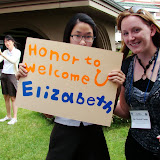
When we pulled up to the school and there was a full out banner welcoming us as honored guests at Daeil Foreign Language High School and my stomach sunk just a little bit as I had the thought, what have I gotten myself into? The nerves started kicking in. We took the elevator and were greeted by students holding signs to individually greet all 35 of us! How awesome! Then, we were told that these were the students were from the classes we would be momentarily teaching and that this was also the student who would be taking us to their homes!

Our classroom experience went very well. We were very warmly greeted by a group of energetic students and dove in! I had two MCC foam bees that went to the two students who won the map challenge we posed. That broke the ice. After that we put them in groups and my partner and I gave out our gifts. Greg had brightly colored bracelets with a note and a pin (like the one Obama wears) and I passed out the postcards my students brought in this spring. The postcards each had messages on them from my students. The Korea students were very excited! The postcards were a huge hit and I used them as a conversation piece for a while, as I shared different things about Florida and got them to speak up and participate. I asked them if anyone had special locations on their postcards and used that to cue my transition to the Kennedy Space Center. I polled the students on what they knew about NASA, shared some fun facts with them, and talked about what kinds of food astronauts eat and then I got to share my freeze-dried ice cream with them – they loved it! The kids were very excited and enthusiastic. My partner Greg then dove in and did a quick lesson on Einstein and his quest as a historian to discover whether Einstein had lived in Greg’s home in NJ or not. (He did!)

The class period was over before we knew it and soon we found ourselves heading to a gift giving ceremony and then met with a teacher from the high school and had the opportunity to pepper him with questions. When we asked about discipline, while he said it is not normally an issue, he informed us that they use corporal punishment. He also explained that to become a teacher you have to pass a government exam to be a public teacher.

After that we met up with our students and they took us home. Taeyeon was very shy at first, but opened up quickly. She showed me her room and pictures and continually asked me questions – especially about my travels. Her mom was very very sweet and her dad worked for Samsung and was very gracious as well. They lived in a Samsung apartment with a beautiful view of the Han River. Dinner was excellent - beef, romaine leaves, hot noodles, kim (seaweed) which you would wrap with rice, and other delicious dishes. I was so flattered that they had gone through so much trouble! They even had a gift for me, a beautiful Korean mirror set. The mirror is supposed to reflect hope of a beautiful life, or something along those lines, I think some of the meaning was lost in translation. I gave them a Wynton Marsalis CD, a favorite of mine and my husband – I really hope they like it!

To end the evening, we went for a walk along the Han River in a beautiful public park. There were many families strolling through the park and young couples picnicking on blankets in the grass. It was a perfect end to the day as Taeyeon, her mother, and myself walked and talked about travel, the Israeli-Palestinian conflict, marriage, the strength of Korean women, and many other things. They dropped me back at the hotel and many of us (teachers) gathered in the lobby to relax and share our experiences. We all had fantastic times! It really was an incredible experience – the Kims welcomed me so warmly. I was truly touched.

My beginning days as a Korea Society Summer Fellow

The past three days have been amazing and I can only imagine what is in store for the next thirteen! They went easy on us for the two days they considered jet-lag days, but we are now in the midst of an unrelenting schedule that has us booked from sun-up past sun-down. We have quite an adventure ahead of us! The Korea Foundation and Korea University have also rolled out the red carpet for us – we truly are receiving the royal treatment!


Day 1: Wednesday 7 July 2010


Day 1: The Korean War Memorial

Click on the image above to view the album

Tuesday morning, I woke up early, and checked out of the hotel. The Park family insisted on helping me navigate the city and make it to meet up with the teacher’s program. Before I knew it we were in the lobby and I was amongst a number of teachers who were all weary from a long trans-Pacific flight. We were mixed in with teachers from both group 1 and group 2 and headed over to the Korean War Memorial. They only had a limited number of seats on the bus, so group one and a few volunteers (myself included) took the subway. **I should note that spending a day with the Parks really gave me an edge…I had a subway pass already, I have seen many shopping areas, I have a lot of inside information about cultural practices from the conversations I’ve had with Jenny…it’s been helpful! : )

We arrived at the Korean War Memorial and were given about thirty minutes to walk around and check things out. I had enough time to walk the grounds and view many of the monuments and historical vehicles, but did not have enough time to explore the museum. As someone who is intrigued by modern history, I have put it on my to-do list and hope to return to the museum in my free time. The monuments were stunning. I am always interested in what symbolism has been incorporated into a monument. One of the statues was a large bronze statue of two brothers embracing each other. The brothers had fought on opposing sides and their faces are wrought with emotion. They are standing on top of a dome that is separated with very jagged edges to symbolize the current separation of the peninsula, but also the hope that they can become reunited at a later date.

There were many rows of military vehicles and weapons to check out including B-52 bombers, Korean fighter planes, US cargo planes, many different tanks and weapons, ships, and my favorite – the missiles. After running around in the sun trying to make every second count I was relieved to collapse in a chair in the auditorium for our first guest speaker. We were extremely fortunate to be graced with the presence of General Paik Sun Yup who was one of the generals leading the Republic of Korea’s military during the Korean War. Even as an elderly gentleman of ninety, he passionately described his version of the war. It is always extremely interesting to listen to different people’s interpretations of events, and this was no different. His lecture style was interesting and was different from the US story-based lecture style. It was such an incredible honor to hear his story!

The remainder of our day was spent getting lunch at a local department store food court. We were mesmerized by the extravagance and multitude of choices in the food court. Afterward, we were deemed free and were able to rest, explore, etc. We each crashed in our own way and prepared for our next adventure.


Day 2: Thursday, 8 July 2010
Day 2: The National Folk Museum

Click on the picture above to view the album

For day two, we headed to the National Folk Museum and were given time to explore the grounds and museum on our own. After having read a detailed book on Korean life and culture, I really enjoyed the life and culture section of the museum that confirmed the different facts I had read and gave me the opportunity to see pictures or artifacts from the rituals and ceremonies I had read about. I was really drawn to the beauty of the Korean craftwork.

After this, we headed to Insadong, a local shopping area, for lunch and shopping. We really enjoyed our wanderings – this shopping area has a little more artsy feel and many of the goods were more customized and tailored. We grabbed a cab with enough time to clean up and prepare for our orientation dinner. At the dinner, we were briefed on the mission of the Korea Foundation, the sponsor of our program and served a beautiful dinner. Again, we were flattered and felt very warmly welcomed!
And then we received our schedule for day three…and braced ourselves.